Why Two Nearly Identical Homes on San Francisco's West Side May Not Be Worth the Same Anymore
September 17, 2026
September 17, 2026
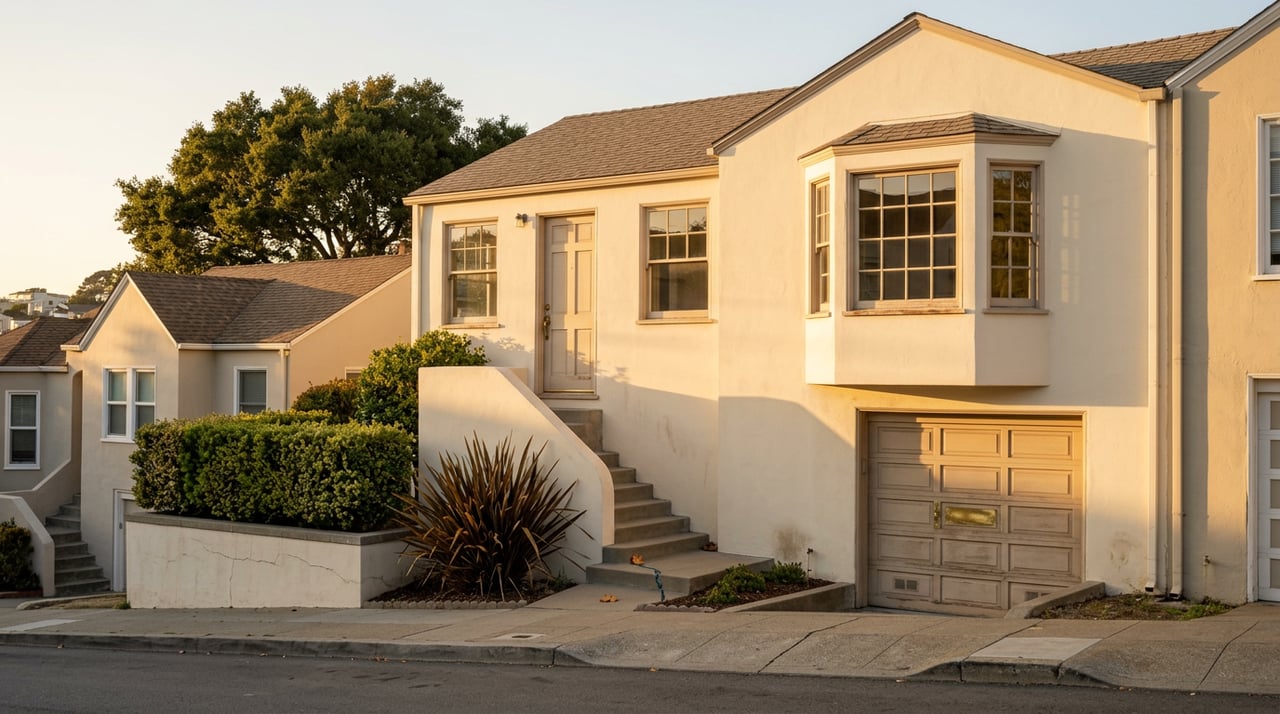
If you're comparing two similar three-bedroom houses on San Francisco's west side this fall, the listing sheets will look almost interchangeable. Same era of construction, same detached garage, same fog-belt landscaping. The number that actually separates them may not show up on either sheet at all. It lives in a zoning file, and as of this year, that file reads differently depending on which side of a line the house happens to sit.
For most of the past decade, San Francisco's west side, West Portal, St. Francis Wood, Forest Hill, Ingleside Terraces, Westwood Park, Mount Davidson Manor, and the neighboring blocks of the Outer Sunset and Parkside, has been thought of as one long stretch of stable, single-family zoning. That stopped being true in the last three years, and the second and larger change only became law this past winter. Anyone comparing homes here now, or pricing one to sell, is working with a map that has two different rule sets layered on top of each other, and most comps still treat it as one.
The first layer arrived in 2023. San Francisco's Board of Supervisors unanimously approved a bill from Supervisors Myrna Melgar and Joel Engardio creating the Family Housing Opportunity Special Use District, a zoning overlay built specifically for west-of-Twin-Peaks neighborhoods and parts of the Outer Sunset and Parkside. It let owners of single-family lots in that district build up to four units where only one stood before, with a streamlined path that skips conditional use authorization, neighborhood notification, and discretionary review.
The second layer arrived in December 2025. San Francisco Planning says San Francisco adopted its Family Zoning Plan, signed into law by Mayor Lurie on December 12 to meet a January 31, 2026 state deadline for compliant rezoning. This plan goes further, and it targets a narrower slice of the same territory: the transit routes, commercial streets, and major intersections running through those same western and northern neighborhoods. On those specific corridors, the plan allows mid-rise buildings of six to eight stories and high-rise buildings of nine stories or more, categories the 2023 overlay never touched.
The practical effect is that a neighborhood name no longer tells you the zoning ceiling. Two lots a block apart in West Portal can now sit under entirely different rules, one capped at four units under the 2023 overlay, the other eligible for a mid-rise project under the 2025 plan, depending on whether that second lot fronts a designated transit or commercial street.
The Family Housing Opportunity Special Use District is worth understanding on its own terms, because it's the layer most west-side owners are more likely to run into. The ordinance authorizes up to four units on an individual RH-zoned lot, up to eight units if two lots are merged, and up to twelve if three are merged, though the lot-merger provisions apply only within RH-1 districts. Eligible projects are exempt from certain height, open space, and rear-yard requirements that would otherwise apply, and they skip the months of discretionary review that used to make small multifamily conversions a gamble on the calendar.
That's a real change in what a west-side lot can become. It's also not the whole story.
Here's the detail that changes the math for an owner or investor actually running numbers on a project: any unit built using the density bonus becomes subject to San Francisco's Rent Ordinance.
That's a deliberate reversal of how new construction usually works in California. Under the state's Costa-Hawkins Rental Housing Act, buildings constructed after 1979 are typically exempt from local rent control. The 2023 legislation carves out an exception to that exemption specifically for units built under its own density bonus, meaning brand-new construction on these lots doesn't get the usual Costa-Hawkins protection.
A four-unit building that qualifies for streamlined approval also locks every one of those units into San Francisco's rent control system from day one, something new construction almost never has to contend with.
One land-use analysis of the ordinance flagged this as a structural tension: the density bonus is the incentive meant to get owners to build, but rent control is exactly the constraint that makes financing and long-term returns harder to pencil for anyone thinking like a landlord rather than a homeowner adding space for family. That tension doesn't make the overlay useless. It does mean the decision to use it looks different for a family wanting a unit for aging parents than it does for someone evaluating a straight investment return.
The Family Zoning Plan operates on a different logic than the 2023 overlay. Rather than applying uniformly across RH-zoned lots in a district, it concentrates new density on the corridors the city has identified as its highest-capacity locations, the major transit routes, commercial streets, and intersections that run through San Francisco's western and northern neighborhoods.
The city's own reasoning for targeting these areas is worth sitting with. Over the past fifteen years, only about 10 percent of San Francisco's new housing was built in these western and northern neighborhoods, even though they cover more than half of the city's land area. The rezoning is San Francisco's response to a state mandate that required the city to show it had removed the barriers that produced that imbalance, using the state's own criteria for identifying areas with higher household incomes, stronger-performing public schools, and lower pollution exposure.
The zoning map itself creates new tools to make that density possible: a Residential Transit-Oriented Commercial zone that allows form-based housing with optional ground-floor commercial space, a new R-4 height and bulk classification, and a Housing Sustainability District where qualifying projects that include on-site affordable units get ministerial approval within 120 days, no discretionary hearing required.
None of this applies evenly across a neighborhood. It applies to the specific parcels the map identifies as sitting on a qualifying corridor, which is exactly why two lots that look the same from the street can carry very different zoning ceilings once you check the map for each one individually.
If you're evaluating a west-side purchase with redevelopment potential in mind, or pricing a property you're planning to sell, the questions worth asking are more specific than "what's the zoning here":
That last point matters more this year than it did last year. According to ADU Zoning, two state laws that took effect January 1, 2026, tightened the timeline for ADU approvals and adjusted owner-occupancy rules for junior ADUs depending on whether the unit shares a bathroom with the main home. For an owner who wants added living space or rental income an ADU remains the more contained path, even on a lot that technically qualifies for the larger density bonus.
None of this shows up in a standard comp sheet. It shows up in the zoning file for that specific parcel, and on San Francisco's west side this year, that file is doing more work than the square footage.
Does every home on the west side now qualify for four units? Only lots within the 2023 Family Housing Opportunity Special Use District boundaries, generally the west-of-Twin-Peaks neighborhoods and parts of the Outer Sunset and Parkside, and only if the lot is zoned RH. Lot mergers that unlock eight or twelve units are limited to RH-1 districts specifically.
If my street wasn't rezoned for mid-rise buildings, does that mean nothing changed for me? Not necessarily. The 2023 overlay's four-unit density bonus is still available to qualifying RH lots regardless of whether that lot also sits on a corridor covered by the newer Family Zoning Plan. The two layers are separate and can both apply, or only one might, depending on the parcel.
Am I required to build the maximum number of units the zoning now allows? No. Nothing in either the 2023 overlay or the 2025 plan requires an owner to build to the maximum. They set a ceiling, not a mandate, and plenty of owners will have no reason to use either provision.
If you're weighing a west-side purchase, a sale, or a redevelopment decision and want a read on how a specific parcel's zoning actually lines up with these overlapping rules, Michael Soon can walk through what applies to your address and what it's likely worth as a result. Schedule a free neighborhood consultation to start with the facts specific to your property, not just the neighborhood average.
This article is general information, not legal, tax or financial advice. Consult a qualified professional about your situation.
Stay up to date on the latest real estate trends.
Understanding his client's goals has helped Michael negotiate successful outcomes buyers and sellers on all types of properties throughout the San Francisco region. Real estate, whether buying or selling, can be quite a journey, and Michael will be there every step of the way.